

Here we have gathered answers to 98 frequently asked questions about ski holidays in the Alps: about the ski resorts, booking, lift passes, equipment, snow conditions and much more. Click on a question to see the answer.

General ski holiday information
The price depends on the destination, hotel standard, time of season and whether you book accommodation with the lift pass included or arrange everything yourself. Resorts such as Flachau or Maria Alm are often more affordable than more exclusive destinations like Ischgl. If you book early, you will usually get both a better price and a wider choice.
Book either early, ideally during the summer or by September at the latest for the weeks around Christmas, New Year and the winter school holidays, or wait for last minute deals and remaining places. The winter school holidays are the most popular period and sell out first. Booking well in advance gives you the widest choice of hotels and the best prices.
A typical stay includes a hotel with breakfast, often half board, and a lift pass for the whole stay. You arrange your own travel there and back. Ski hire and ski school are rarely included automatically, but can usually be added when booking. Always read carefully what is included before completing your booking.
Booking the hotel and lift pass together is often good value, as discounted rates have been negotiated on both accommodation and lift passes. If you book everything separately, you can sometimes find lower prices if you are flexible, but this requires more planning and you will need to keep track of every part of the stay yourself.
The most affordable weeks are usually at the end of November and beginning of December, as well as at the end of March and in April as the season draws to a close. Avoid the weeks around Christmas, New Year and the winter school holidays, which are the most expensive periods. Easter can also be pricier, but it usually offers excellent spring snow.
Consider the ability level of your group, the range of pistes you want (both variety and difficulty), your budget and how far you are willing to drive. A family with beginners will do best at an easy going resort such as Flachau or Maria Alm, while experienced skiers often head for Ischgl, Sölden/Obergurgl or St. Anton. Snow reliability also varies, and resorts at higher altitude tend to be more reliable.
Yes, comprehensive travel insurance with accident and cancellation cover is strongly recommended. Standard home contents travel cover does not always extend to ski injuries, so make sure your policy covers helicopter rescue, hospital stays and travel home if needed. Check that the insurance specifically covers alpine skiing.
Absolutely. Every ski resort in the Alps has ski schools with professional instructors who teach in English, and most resorts have dedicated beginner areas with gentle lifts and easy practice slopes. It is worth booking a beginner package with at least three to five days of lessons, as this gives you a much better foundation than trying to learn on your own.
Half board means breakfast and dinner are included in the hotel price, while full board also includes lunch. Half board is the most common option on a ski holiday and works well, since most people are out skiing at lunchtime or grab a light meal on the slopes. Full board can suit you if you want predictable costs and prefer not to buy food yourself.
Set aside money for lunch, coffee and apres-ski each day, as well as any ski hire and lift pass costs if these are not already included. In resorts with a lively nightlife such as Ischgl, evening expenses can add up considerably. If half board is included, it is usually enough to budget for lunch and snacks on the slopes.
Most ski resorts offer hire of pulks and sledges, and many hotels have equipment available to borrow. Sledging slopes and snow play areas can be found at most family friendly resorts such as Flachau, Maria Alm and Wagrain. Ask your hotel or the local tourist office about what is available, as the offering varies quite a bit from place to place.
A lift pass gives you access to the lifts and gondolas in a ski area for a set period. The pass is a chip card that you hold up to the reader at each lift. Many resorts form part of larger ski areas with a shared pass. The Ski amadé pass, for example, gives you access to 760 pistes across 25 resorts, including Flachau, Wagrain and Schladming.
Many resorts offer ski school from age 3 to 4, with specially adapted teaching methods, playful practice slopes and dedicated children's lifts. Children under 3 are rarely ready for skiing, but they usually enjoy snow play areas and sledging slopes. Resorts such as Flachau, Maria Alm and Wagrain typically have excellent children's programmes.
Austria
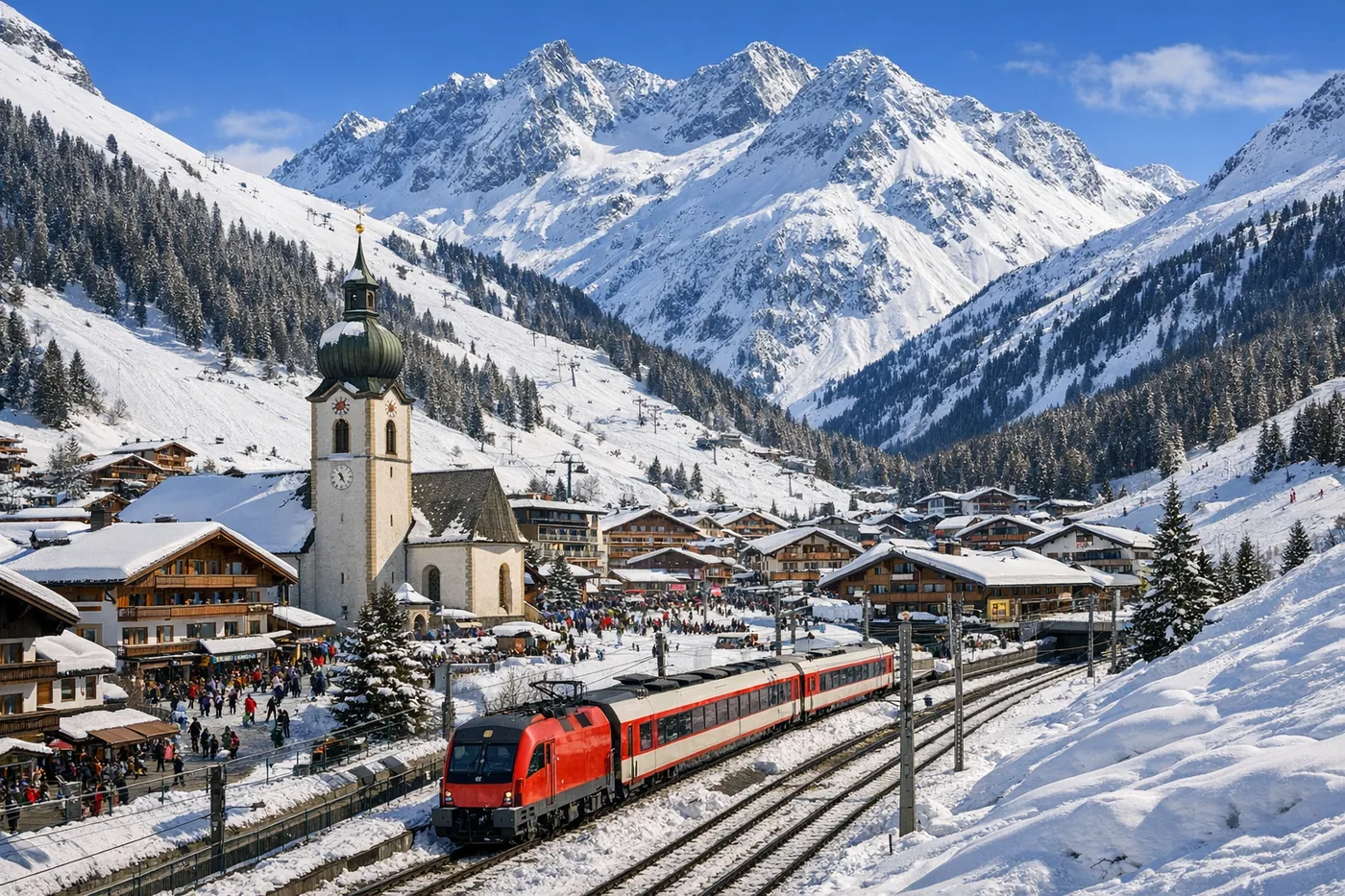
Austria combines fantastic alpine scenery with well organised infrastructure, a rich food tradition, cosy mountain huts (Hütten) and lively apres-ski. The country has ski areas for every level and budget, from the family friendly Wagrain and Flachau to world famous destinations such as Ischgl and St. Anton.
Ski amadé is one of the world's largest ski areas, with a shared lift pass giving access to 760 kilometres of pistes and 270 lifts spread across 25 resorts. Among the most visited are Flachau, Wagrain, Schladming, Zauchensee and Maria Alm. The pass can be bought per day or per week, and it's an excellent choice if you want to explore several resorts during your stay.
Ischgl is one of the Alps' most exclusive and well known ski resorts, with 238 kilometres of pistes and a connected ski area with Samnaun in Switzerland. The resort is known for its lively apres-ski scene, luxurious accommodation and its season opening concert in November. The area enjoys high snow reliability thanks to its location between 1,400 and 2,872 metres above sea level.
St. Anton am Arlberg is regarded as one of the birthplaces of alpine skiing and forms part of the Arlberg area, with a combined 305 kilometres of pistes across St. Anton, Lech, Zürs and Stuben. The resort is known for its challenging off-piste terrain, steep black runs and a vibrant nightlife. The area suits experienced skiers best.
Yes, Obertauern is one of Austria's most snow sure ski resorts thanks to its high location at 1,740 metres, with peaks reaching up to 2,350 metres. The resort typically has reliable snow from November to April and is known for its circular ski area, where you can ski a large loop. It's a popular choice if you want to feel confident about good snow conditions.
Together with Leogang and Fieberbrunn, Saalbach-Hinterglemm forms the Skicircus Saalbach ski area, with 270 kilometres of pistes. The area is known for its mix of red and black runs, lively apres-ski along the valley floor and the chance to ski the whole area in one large loop. It's one of the most complete resorts in Salzburger Land for families and entertainment alike.
Schladming is a versatile ski resort with 230 kilometres of pistes spread across four connected mountains (Planai, Hochwurzen, Hauser Kaibling and Reiteralm). The Planai slope hosts alpine World Cup races and offers technical, challenging skiing. The area suits all levels, but is especially popular with experienced skiers and those who appreciate a natural feel to the pistes.
Bad Gastein is one of Austria's most exclusive and historic spa towns, offering a unique combination of skiing, thermal baths and impressive Belle Époque architecture. The ski area in the Gastein Valley has 200 kilometres of pistes across three resorts and suits everyone from beginners to advanced skiers. The spa and wellness facilities make it perfect if you want to combine skiing with relaxation.
All three are excellent choices for beginners, but Flachau and Wagrain offer a slightly more structured setup with large ski schools and good beginner slopes. Maria Alm, in the Hochkönig area, is quieter and more family oriented, with fairly flat practice areas and fantastic views. All three are part of Ski amadé, giving you the chance to expand your skiing during the week.
Dachstein West, near Gosau and Russbach, is an overlooked but charming ski area with 50 kilometres of pistes that suits families perfectly. The slopes are wide and moderately steep, the lift queues are shorter than in the better known neighbouring resorts, and the area is part of Ski amadé. It's a peaceful alternative for families who want to avoid the stress of the big crowds.
Zauchensee is a small but exclusive ski resort at 1,360 metres, with peaks reaching up to 2,188 metres, known for high snow reliability and wide, sunny pistes. The resort is part of Salzburger Sportwelt (part of Ski amadé) and has a calm, family friendly atmosphere without an overly busy nightlife. It's a popular choice if you want good snow while avoiding the hustle of the larger towns.
Lofer is a picturesque village in the Salzburger Land with a compact ski area of 42 kilometres of pisted runs. The area has a good mix of green and blue runs, making it well suited to beginners and families, and the charming village with its Austrian tradition makes the experience all the more enjoyable. It is a good value option without overcrowded restaurants and long queues.
Obergurgl-Hochgurgl is one of the most snow sure resorts in the Alps, situated between 1,930 and 3,080 metres above sea level, with a season running from November to April/May. The resort is car free, small and exclusive, with 110 kilometres of pisted runs and an atmosphere of seclusion and calm. It suits you perfectly if you prioritise snow quality and a more exclusive setting.
Ischgl regularly ranks among the best apres-ski resorts in the Alps, with well known clubs, live concerts and a party atmosphere that kicks off the moment the lifts close. St Anton also has a legendary nightlife, with spots such as Mooserwirt and Krazy Kanguruh. Saalbach and Obertauern offer lively alternatives if you want atmosphere without Ischgl prices.
Yes, with a Ski amade pass you can switch between Flachau, Wagrain, Schladming, Zauchensee and over 20 other resorts within the same week. Bus and train connections exist, but travelling by car is the simplest option. The Arlberg pass gives you access to St Anton, Lech and Zurs all in one. Trips combining several resorts like this suit experienced skiers keen to explore.
Zell am See and Kaprun together form the Europa Sport Region ski area with 138 kilometres of pisted runs, plus a unique bonus in the form of the Kitzsteinhorn glacier area, which stays open all year round. The lift system is modern and well maintained, with fast gondolas and express chairlifts. The combination of skiing by the lake and on the glacier makes Zell am See one of the most picturesque and versatile destinations in Austria.
Prices vary from one ski area to another, but you should expect to pay around 300 to 400 euros for an adult weekly pass at most Ski amade resorts. Ischgl and the Arlberg area sit a little higher, at around 350 to 420 euros per week. Children under 15 often ski at a heavily reduced price, and in some places for free when accompanied by a paying adult. Always buy your lift pass online in advance, as it is cheaper than buying it at the ticket window.
The Arlberg area, comprising St Anton, Lech, Zurs and Stuben, has 305 kilometres of pisted runs and is considered one of the largest connected ski areas in the Alps. Ski amade is even bigger, at 760 kilometres, but that requires travelling between resorts by bus or car. As a compact large ski area where you can get around entirely by lift, Arlberg is hard to beat in Austria.
Most Austrian ski resorts offer plenty beyond the pistes: biathlon ranges, dog sledding, snowshoe walks, ice climbing, sledging, thermal baths (Bad Gastein, Zell am See), shopping and walks along groomed winter trails. In Bad Gastein and Kaprun, the snow experience is complemented by spectacular thermal baths. Most resorts also have well developed wellness facilities at the hotels.

Italy: Livigno and Canazei
Livigno draws visitors with its unique duty-free status (lower prices on alcohol, perfume and electronics), excellent snow conditions thanks to its altitude of 1,800 to 3,000 metres, and a compact, family friendly ski area with 115 kilometres of pisted runs. The atmosphere is relaxed, and the price level is generally lower than at the most exclusive alpine destinations. Its location right on the border with Switzerland makes it a bit out of the way, but it also gives the resort a special feel of an isolated mountain village.
Livigno has long held a special duty-free status within the EU, which means lower prices on alcohol, tobacco, perfume, cosmetics and fuel. Spirits and wine are noticeably cheaper than at home, and many people take the opportunity to bring back their permitted duty-free allowance. Prices on food and ski equipment, however, are not significantly lower than at other alpine resorts.
Yes, Livigno offers a well balanced setup with plenty of green and blue runs, a wide beginner area down in the valley and well organised ski schools. The valley is wide and open, giving beginners plenty of room to practise without feeling exposed to steep drops. Snow conditions are reliable, which gives extra reassurance to anyone who has only just learned to ski.
Livigno has a lively but not overwhelming nightlife, with a good mix of bars, pubs and restaurants along the main street. Thanks to its duty-free status, alcohol is cheaper than in most other alpine resorts. The atmosphere is more family friendly than in, for example, Ischgl, but there is still plenty on offer for those looking for evening entertainment.
Canazei is a picturesque village in Val di Fassa in the Dolomites in Trentino, with 150 kilometres of pistes and views of the spectacularly beautiful limestone peaks in the UNESCO-protected Dolomites landscape. The resort forms part of the vast Dolomiti Superski system, which gives you access to over 1,200 kilometres of pistes on a single lift pass. Val di Fassa is known for its authentic Ladin culture and excellent food.
Canazei sits at altitude (1,465 to 2,905 m) and is generally fairly reliable for snow, particularly in the upper parts of the Belvedere area. Artificial snow tops up the natural snow in the lower sections. The limestone geography of the Dolomites can produce different weather patterns to the western Alps, but the high peaks hold on to their snow well throughout the season.
Dolomiti Superski is arguably the most famous lift pass in the world, giving you access to 1,200 kilometres of pistes and 450 lifts across 12 ski areas in northern Italy, including Val di Fassa/Canazei, Val Gardena and Alta Badia. The pass is among the priciest in the Alps, but it is the ultimate choice if you want to explore the Dolomites properly. Canazei is included in this large pass.
In Livigno, simple, tasty Italian and Alpine food dominates: polenta, risotto, pizza and pasta. Prices are reasonable, especially in the shops thanks to the tax-free status. Canazei and Val di Fassa offer richer gastronomy, with traditional Ladin dishes, local wines from Trentino-Alto Adige and wonderful mountain restaurants (rifugi). The food is part of the experience in both places.
As well as skiing, Canazei offers impressive winter walks along the valley floor with views of the Marmolada glacier, bathing and wellness at the Val di Fassa Spa, and day trips to the beautiful villages of Pozza di Fassa and Moena. The Dolomites are themselves a World Heritage site, and the dramatic landscape is an experience in its own right. The centre has a small but charming selection of restaurants and shops.
Switzerland: Grindelwald
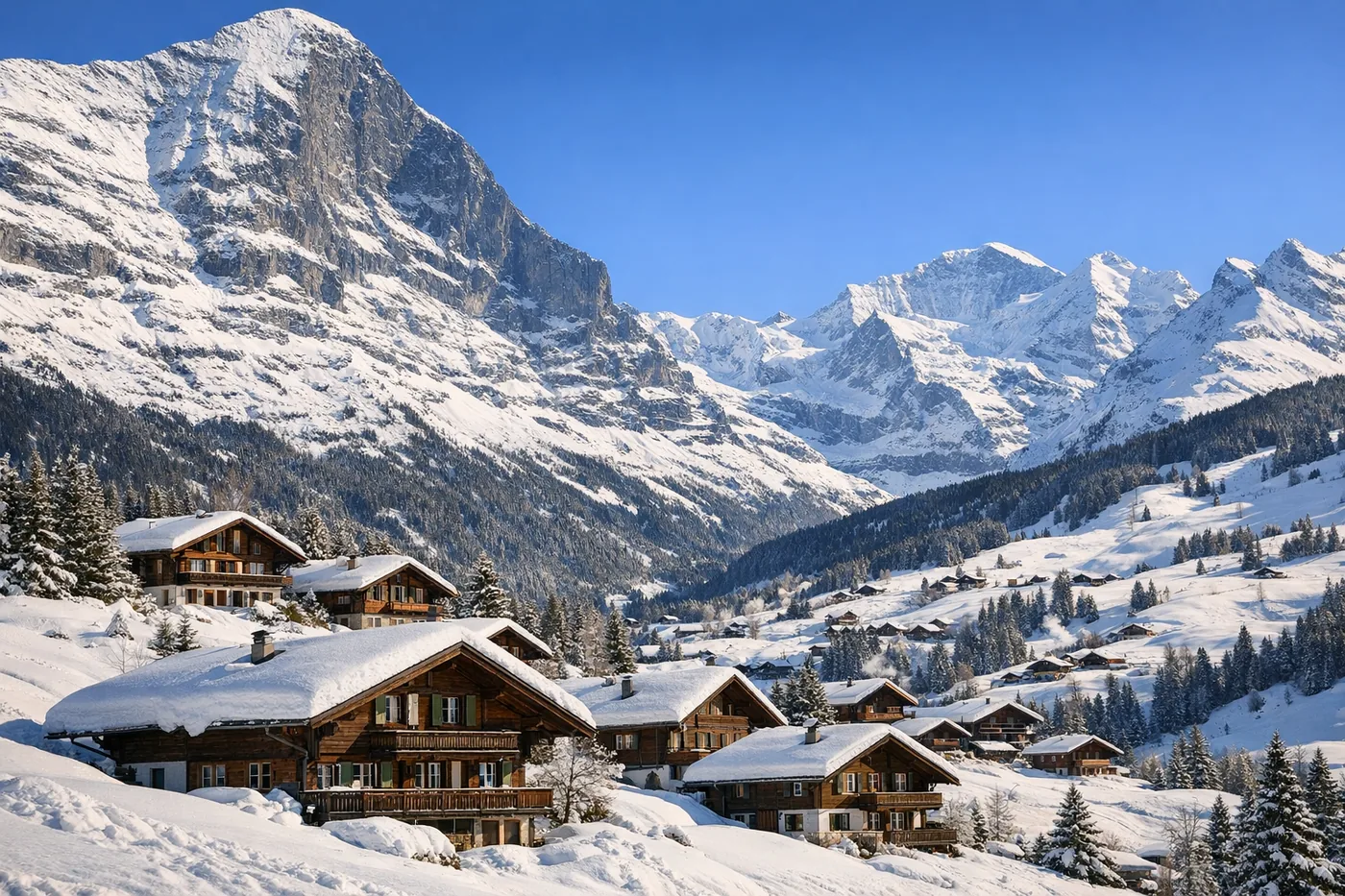
Grindelwald in the Bernese Oberland offers one of the Alps' most dramatic landscapes, with views straight towards the Eiger, Mönch and Jungfrau. The Jungfrau ski region is impressive, with 213 kilometres of pistes and one of Europe's most modern lift systems, including the world's fastest cable car up to the Jungfraujoch. The area is well preserved and protected, with authentic Swiss charm.
Switzerland is generally more expensive than Austria and Italy. A weekly pass in the Jungfrau region costs around 400 to 480 CHF. Food, accommodation and ski hire are also pricier than in comparable Austrian resorts. In return, you get exceptionally beautiful surroundings and first-class infrastructure, and many feel the experience is worth the price.
Grindelwald is best suited to intermediate and advanced skiers, since many of the pistes are moderately steep or steep, though there are beginner slopes in the First and Kleine Scheidegg areas. The ski school in Grindelwald has a good reputation. Beginners should still be aware that a bit more courage and fitness is required here than in more gentle resorts.
The Jungfraujoch (the Top of Europe), with its ice palace and observatory, is an unforgettable trip and is reached by cable car directly from Grindelwald. The First Cliff Walk and Glacier Canyon are summer activities, but the winter setting also offers fantastic walking opportunities. The village has good Swiss restaurants, fondue spots and a calm, well-kept centre that invites relaxation.
Grindelwald is most easily reached by car, giving you full flexibility to bring your own gear and explore the surrounding valleys at your own pace. For those who prefer not to drive the whole way, Switzerland's train network is exceptionally well organised, with direct services running all the way to Grindelwald station from Zurich (around 2.5 hours) or Bern (around 2 hours). Do note that parking in the village is limited during peak season, so it is worth planning ahead.
Practical information
The most important thing is to dress in layers: a moisture-wicking base layer next to the skin (avoid cotton), an insulating mid-layer (fleece or a down vest) and a windproof, waterproof outer layer (ski trousers and a ski or snowboard jacket). Mittens or gloves, a hat or helmet liner, ski goggles and sun cream with UV protection are essential. Do not forget thick socks in wool or synthetic material, never cotton.
Hiring is the smartest option for beginners and for those who ski less than once a year. Servicing and binding adjustment are included in the hire price on site, and you avoid lugging heavy luggage around. If you ski more than 2 to 3 times a year and have reasonably good technique, owning your own skis pays off in the long run. You should always wear a helmet, so hire one if you do not have your own.
Always book your ski hire online in advance. It's cheaper (often a 20-40% discount compared with the price on arrival), you avoid queuing, and at some resorts you can collect the equipment the evening before your first day on the slopes. Well-known chains such as Intersport and Sport 2000 are found at most resorts and offer good online booking. Enter your details (height, weight, shoe size, skill level) correctly so the bindings can be set up properly.
A helmet is strongly recommended, and at an increasing number of resorts it's compulsory for children under 14-16. Studies show that helmets significantly reduce the risk of serious head injuries from falls and collisions. A rental helmet costs around 5-10 euros per day. If you own one, bring it along.
A week's ski hire for adults normally costs 100-180 euros online, depending on the resort and equipment class. Beginner equipment (so-called "fun carvers" or standard models) is cheaper, while performance skis cost more. Children's hire is often more affordable. Book early and online for the best price.
You need travel insurance with extended cover for active sports, including accidents, hospital treatment, helicopter evacuation and repatriation in the event of illness or injury. Check whether your home contents insurance covers skiing accidents abroad, as most don't. Cancellation cover is recommended in case of illness, especially if you've booked well in advance.
No, EU and EEA citizens don't need a visa for Austria (EU) or Italy (EU). Switzerland isn't part of the EU but is part of the Schengen Area, so a valid passport is enough. Check that your passport hasn't expired, and always carry valid ID with you when travelling.
Austrian and Italian menus are often clearly marked with allergens. Gluten-free and vegetarian food is becoming increasingly common at mountain restaurants and eateries throughout the Alps. Let your accommodation and ski school know if you have serious allergies. At more remote resorts, the selection may be limited. One option is to book accommodation with kitchen facilities.
The European Health Insurance Card (the blue card) entitles you to healthcare in Austria and Italy at the same cost as local residents pay, but it doesn't always cover private clinics or helicopter transport. In Switzerland, the card doesn't apply in full. The health insurance card doesn't replace proper travel insurance, but should be seen as a supplement to it.
Pistes are marked with colours according to difficulty: green (beginner, gentle), blue (easy to intermediate), red (moderately challenging, the most common), black (difficult, steep), and in some areas orange or yellow for extreme runs. Most adult beginners start on green and blue pistes. Black runs require solid skiing experience and shouldn't be taken lightly.
Moguls are bumps formed by skiers' turns in ungroomed snow. They require technique and good knee control to ride smoothly. Off-piste means skiing outside the groomed runs, in untouched natural snow. Off-piste skiing requires solid experience, knowledge of avalanche risk, the right equipment (avalanche transceiver, shovel, airbag pack) and should never be done alone without a guide.
Snowboarding is welcome on virtually all pistes and in all snow parks across the Alps. The technique differs from skiing. Beginners often need a little more time to get going, but it pays off. Always wear wrist and knee protection, and ideally a helmet too. Off-piste terrain and snow parks are the most popular choices among snowboarders.
Contact the lift pass office or the ski lift company's service desk straight away. Always keep your receipt or confirmation email with you. With ID and this, most lift pass offices can block the lost pass and issue a new one for an administration fee. Digital lift passes via app are becoming more common, making theft more difficult.
Snow and season
Most ski resorts open at the end of November or in early December, but high-altitude resorts (Obergurgl, Ischgl, Livigno) often have runs open from November onwards. The glaciers at Kaprun and Hintertux offer skiing all year round. The season typically lasts until April, and high-altitude resorts may stay open into May. Exact opening dates vary with snowfall and are published by each individual resort.
January and February are generally considered the best months for snow quality: cold, dry snow and long days make for excellent skiing. The winter half-term holidays are a popular period, but prices are higher. March often brings lovely spring snow, more sun and lower prices. December can be unreliable, but resorts such as Obergurgl and Obertauern are safer choices early in the season.
Natural snow falls from the clouds and varies in consistency depending on temperature and humidity. Artificial snow is produced by snow cannons from water and is harder, denser and better suited to piste grooming when temperatures rise above freezing. Most modern ski resorts cover 60 to 100 per cent of their piste network with snow cannons as backup, which ensures the season stays open even when natural snowfall is scarce.
Obergurgl-Hochgurgl, Ischgl and Obertauern are regarded as the most snow-sure Austrian ski resorts, thanks to their high altitude (1,700 to over 3,000 metres) and plentiful snowfall. Zauchensee and Saalbach-Hinterglemm are also reliable. Lower-lying resorts such as Lofer and Dachstein West can be more prone to snow shortages in mild winters.
Some providers offer a snow guarantee, which means you can cancel or amend your booking free of charge if the snow depth falls below a certain level (for example, fewer than a given number of open piste kilometres). Always read the small print, as the requirements and form of compensation vary. If you choose a high-altitude resort with snow cannons, the risk of needing to rely on the snow guarantee is reduced.
Powder days are days with fresh, untouched natural snow that gives a soft, floating feeling to your skiing. They're sought after at every level, but especially among off-piste skiers. Keep an eye on resorts' snow reports and weather forecasts via apps such as Windy and Meteo.io, or the resort's own website. Get out early in the morning, as the powder gets tracked out within a few hours on the popular slopes.
Avalanche risk is shown on a five-level European scale (1 = low, 5 = very high) and is published daily for each region. Off-piste skiing at risk level 3 or higher should only be undertaken with an experienced guide and the right equipment (probe, shovel, avalanche airbag). On groomed pistes the risk is minimised, but during heavy snowfall certain runs may be temporarily closed for avalanche control.
March is an excellent month, with long days, plenty of sunshine, good snow conditions and lower prices than in peak season. The spring snow can turn a bit slushy in the afternoon as the sun warms it up, but in the mornings the pistes are often firm and freshly groomed. Higher-altitude areas keep their snow throughout March, and lift passes are often cheaper than in the middle of the season.
At temperatures below minus 15 to 20 degrees, wind chill can make conditions uncomfortable, with a risk of frostbite on exposed areas such as cheeks, ears and nose. Dress appropriately with a balaclava or face mask, wear good gloves and make sure your outer layers are waterproof. Lifts rarely close due to cold alone, but strong winds can temporarily halt gondolas and chairlifts.
A snow report usually includes snow depth in the valley and at the summit (in centimetres), snow type (powder, packed, icy), the number of open pistes and lifts, the most recent snowfall recorded and the weather forecast for the coming days. Good sources include Bergfex.com and the resort's official website. Always compare the snow depth at the summit with that in the valley, as the difference can be considerable.
Families and beginners
Flachau, Wagrain and Maria Alm in the Ski amadé region are among Austria's best family destinations, with well-organised ski schools, playful children's slopes, sledging areas and family-friendly hotels. Dachstein West (Gosau) is a quieter alternative with shorter queues. Obertauern and Saalbach suit older children and teenagers who want more speed and a wider choice of black runs to explore.
Most ski resorts offer childcare (ski kindergarten or kinderland) for children aged 2 to 3, combining play in the snow with simple ski instruction from age 3 to 4. The day is structured educationally, with safe, fenced practice areas and instructors experienced in working with children. Let the resort know about any allergies, dietary needs or special requirements when you sign up.
Group ski school for beginners normally costs 120 to 200 euros for a five-day week with 2 to 3 hours of tuition per day. Private lessons cost 60 to 100 euros per hour depending on the resort and the instructor's experience. Private lessons are recommended if you want rapid progress, or if your group has very different skill levels. Always book well in advance, as groups fill up quickly in peak season.
A five-year-old measuring 105 to 120 cm usually needs skis of 80 to 100 cm. The ski hire shop will advise based on the child's height, weight and shoe size. Ski boots (around size 21 to 23 EU) and a helmet are the most important items. Choose a boot that doesn't pinch, and a helmet that fits well. Equipment for children is almost always included in the hire packages at the resorts.
At ski resorts, snow-covered streets and footpaths can sometimes be tricky for ordinary prams. A pulk sledge or specially adapted snow buggy is preferable. Hotels usually have pulks to lend, and most places have well-groomed walking paths along the valley. Gondolas and cable cars sometimes accept prams, but check with the lift company beforehand.
Saalbach-Hinterglemm, Schladming and the resorts in Ski amadé (Flachau, Wagrain) offer a very wide range covering everything from beginners to advanced skiers within the same ski area, which suits families or groups with varying experience well. Grindelwald suits groups better if they're already reasonably confident on skis. Avoid St. Anton for mixed groups with beginners.
The vast majority of beginners manage, after three days of group ski school, to ski down easy blue runs with controlled turns. A full week gives you a solid foundation for skiing independently on blue and easier red runs. Children often learn faster than adults. Private lessons give faster progress, but cost more.
Sledging hills, snow play, ice rinks, dog sledding, snowshoeing and indoor pools are available at most family-friendly resorts. Aquadome in Ötztal and Salzburgerwasser Welten near the Ski amadé region are popular family attractions. Events such as Kindertag (children's day), with half-price lift passes, are held regularly by the ski resorts throughout the season.
Ski-in ski-out means you can put your skis on right outside the hotel door and ski straight onto the piste, then ski all the way back to the hotel at the end of the day without changing into ordinary shoes. It's extremely practical, especially with children. These hotels tend to cost more, but they save a lot of time and stress, particularly if you have young children who need help with their equipment.
Teenagers are often placed in age-appropriate groups (teen groups) at ski school, which makes learning more social and motivating. Freestyle programmes, snow parks and an introduction to off-piste skiing are popular in this age group. Saalbach, Ischgl and Schladming all have well-organised youth programmes. A private instructor can also be tailored to a teenager's specific interests and level.
Apres-ski and activities
Apres-ski is the social party that starts as soon as the lifts close (usually around 4 to 5pm) at bars by the slopes, in mountain huts and in pubs down in the valley. It ranges from a relaxed beer still in your ski boots to a full dance party on platforms right below the slopes. Ischgl and St. Anton are legendary, while Flachau and Schladming offer quieter but enjoyable alternatives.
Mooserwirt and Krazy Kanguruh in St. Anton are icons of alpine nightlife. Pacha in Ischgl is one of the Alps' most famous nightclubs. Goaßstall and Hinterhag-Alm in Saalbach are hugely popular. In Schladming, Hohenhaus Tenne is legendary, and Obertauern has a well-known cluster of bars along the valley floor. Pop in early in the evening if you want to avoid the biggest rush.
A half-litre of beer at a mountain hut or bar in Austria costs around 4 to 7 euros depending on the location. Ischgl is more expensive, Flachau a bit cheaper. In Switzerland, expect 7 to 10 CHF. In Livigno, prices are lower thanks to its duty-free status. At apres-ski spots with live music and a dance floor, prices tend to be noticeably higher.
Snowmobile tours, dog sledding, ice climbing, cross-country skiing, curling, winter shopping, spa and wellness facilities, indoor tennis lessons, boules and guided nature walks are typical extras. In Bad Gastein you can bathe in geothermal pools, in Kaprun there's an ice cave, and in Grindelwald the train takes you up to Jungfraujoch. Each resort has its own character, so check the destination's activity page.
Night skiing on floodlit runs is offered on selected slopes at several resorts in Austria. Schladming, Flachau and Saalbach keep slopes lit until 10 or 11pm a couple of evenings a week. It's a special experience under atmospheric lighting and popular among skiers of all levels. Check the resort's schedule before you travel.
Mountain restaurants (Hütten in Austria and rifugi in Italy) are a central part of the Alpine experience, with food ranging from simple sausages and chips to proper three-course lunches. In Austria, knödel, schnitzel and Kaiserschmarrn are classics, while in Italy pasta, polenta and risotto dominate the menu. Popular huts are fully booked in high season, so arrive early or book a table in advance.
Yes, in most resorts it is possible to hire a mountain restaurant or a private hut exclusively for your group, often with catering, an open fire and sometimes live music. This requires early booking, months ahead in high season, and a minimum spend. Contact the local tourist office or the hut owner directly for prices and terms. It makes for a fantastic experience for groups of 15 to 50 people.
Hot air balloon flights are organised in certain Alpine regions during winter and offer an unforgettable panoramic view over the snow-covered mountains. This is a weather-dependent seasonal activity booked in advance through local operators. Grindelwald and parts of Austria, including the Salzkammergut, have balloon flight providers. Always check the weather forecast, as calm conditions are essential.
Snowshoeing along marked trails is a great option that requires no previous experience. Cross-country skiing, ice skating, dog sledding and thermal baths (in Bad Gastein and Zell am See) are all popular. If you're interested in culture, you can explore the local history, architecture and museums of the resorts. Grindelwald offers mountain railway adventures to Jungfraujoch without needing a lift pass at all.
English works well in almost all tourist settings in the Alps, whether at ski school, your hotel or in restaurants. That said, a little basic German ("Entschuldigung" for "excuse me", "Danke" for "thank you", "Eine Halbe, bitte" for "a half litre, please") is always appreciated and can open doors. In Canazei and Val di Fassa, Italian is the main local language, but English and German are understood by most people working in tourism.
Summer holiday: Schladming and Wagrain
In summer, Schladming transforms into a paradise for hiking, mountain biking and nature experiences in the Ennstal valley and the Dachstein massif. The gondolas and lifts remain open and carry both bikes and walkers. The summit of Planai offers a fantastic panoramic view, and the Dachstein ice cave is a unique visit. Summer is the low season, with a relaxed atmosphere, making it an excellent alternative to a beach holiday.
Wagrain, in the Pongau valley, is a scenic summer destination with excellent infrastructure for cycling, hiking and golf. The lifts open up for mountain biking, and there is a well-marked network of hiking trails for all levels. Families with children appreciate the peaceful lakes nearby, and the resort has a pleasant, relaxed atmosphere without the stress of the winter crowds. Prices are noticeably lower in summer.
Summers in the Salzkammergut and Ennstal are warm, with temperatures of 20 to 28°C down in the valley. Afternoon showers are common in the mountains, so always bring a rain jacket when hiking. The altitude brings cooler air and is perfect for an active holiday. July and August are the warmest months, while June and September are quieter, with fewer visitors.
Yes, Schladming is excellent for families with children in summer, offering mountain bike hire for kids, playgrounds, natural pools and guided family walks. Planai Zoo and the climbing parks are popular activities for children. Short gondola rides and easy trails with fantastic views suit all ages. Accommodation standards are high, and many hotels offer their own children's menus.
Yes, the Pongau region around Wagrain has several beautiful Alpine lakes, such as those near Filzmoos and Zauchensee, where you can swim and fish. The water is fresh and clear, though it can be cool (14 to 18°C), and truly refreshing on a hot summer's day. The swimming spots are natural and uncommercialised, unlike at coastal resorts, offering an authentic nature experience.
In winter, Schladming is dominated by skiing, resort culture and apres-ski, while hiking, cycling and nature experiences take over in summer. Prices for accommodation and activities are generally lower in summer. The atmosphere is calmer and more family-friendly. Some hotels and restaurants have shorter opening hours outside the ski season.
Schladming is one of Austria's leading centres for mountain biking, with the Planai Bike Park, technical enduro trails and a well-signposted network of XC trails for all levels. The gondola carries bikes for free or for a small fee. Bikes, including e-bikes, can be hired in the village. Many Austrian and German cyclists travel here in summer, so book your accommodation early if you're planning a trip in July.
Dachstein Eishöhle (the ice cave) and Mammuthöhle (the mammoth cave) are spectacular attractions with impressive ice formations and enormous cave passages. The gondola ride up and the cave ticket together cost around 30 to 40 euros, but offer an experience out of the ordinary. Note that the temperature in the cave is close to zero degrees, so bring a jacket. Book a guided tour in advance during the busy summer season.
Schladming hosts the Planai Classic and the World Cup night slalom in January and February. During the competition weeks, the town is packed with tens of thousands of visitors, and the atmosphere is electric with concerts, light shows and festivities. It is a fantastic experience for anyone who loves skiing, but it means you need to book your accommodation many months in advance, and prices reflect the high demand.