
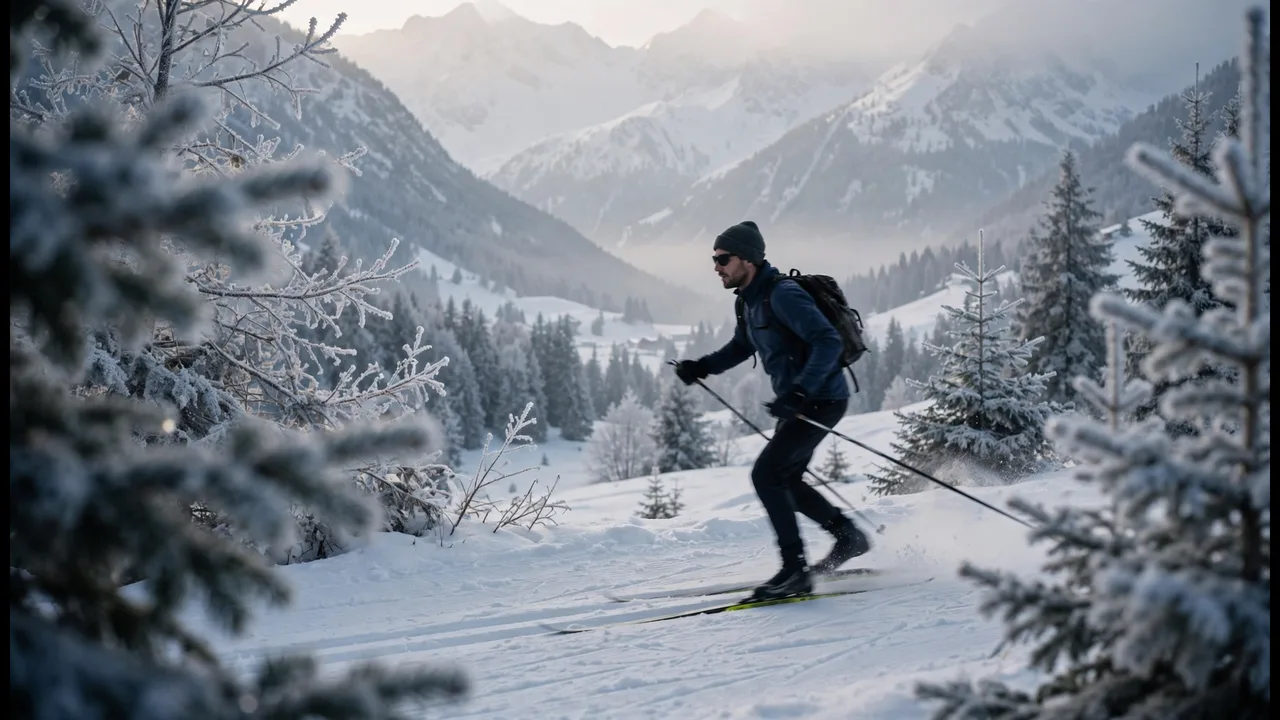
Cross-country skiing amid the Alpine world
The Alps are best known for downhill skiing, but many resorts also have excellent cross-country trails, and for those who enjoy both it's perfect: mornings on the slopes, afternoons on the trails. The trails often lie in the valley floor or on sunny plateaus, with mountain backdrops that make the outing something special. The altitude also provides reliable snow: several of the resorts below have trails at over 1,600 metres that hold snow throughout the season.
Classic tracks and skate lanes are groomed daily at the larger resorts, and at every resort in this guide you can hire cross-country equipment locally. Just note that a trail pass is required at some resorts: in France and Switzerland a charge is most common, while many Austrian trails are free.
The resorts with the best cross-country skiing
The table shows the groomed trail length per resort according to each resort's official figures. Click on a resort to read more about accommodation, slopes and booking.
Drag the table sideways to see all columns.
| Resort | Country | Cross-country trails | Worth knowing |
|---|---|---|---|
| St. Moritz/Engadin |  Switzerland Switzerland |
over 240 km | Switzerland's largest cross-country area. The Engadin Skimarathon runs partly across frozen lakes. |
| Schladming-Dachstein |  Austria Austria |
approx. 220 km | Includes the cross-country mecca Ramsau, World Championship host in 1999. Glacier trails at over 2,500 m. |
| Val di Fiemme |  Italy Italy |
approx. 150 km | Finish venue for the Marcialonga. The Lago di Tesero cross-country stadium decides the Tour de Ski final. |
| Selva Val Gardena | Italy |
145 km | 29 km in the Vallunga nature reserve and 25 km at the Monte Pana cross-country centre. |
| Zell am See-Kaprun | Austria |
107 km | Mostly flat valley trails suitable for beginners. Several floodlit evening trails. |
| Davos | Switzerland |
over 100 km | Plus 75 km of skate trails, a trail for dogs and the 42 km "Königsetappe". |
| Cortina d'Ampezzo | Italy |
approx. 70 km | Part of Dolomiti Nordicski with a total of 1,300 km of trails. Home to the classic Dobbiaco-Cortina race. |
| Kitzbühel | Austria |
approx. 70 km | All 16 trails are free. The longest trail, towards Aurach and Jochberg, is 17.8 km. |
| Chamonix |  France France |
approx. 60 km | Trails run the length of the valley from Les Houches to Vallorcine. A trail pass is required. |
| La Clusaz | France |
53-65 km | Les Confins was a World Cup venue from 1987 to 2016. Trail connection to Le Grand-Bornand. |
| Arosa Lenzerheide | Switzerland |
over 50 km | Floodlit trail in Lantsch/Lenz on the loop used for the Tour de Ski. |
| Megève | France |
approx. 45 km | The largest Nordic area is La Livraz-Côte 2000, with evening skiing. |
| Engelberg | Switzerland |
42 km | 25 km valley trail for classic and skate skiing. Trails are free with a guest card. |
| Bad Gastein | Austria |
approx. 40 km | High-altitude trail in Sportgastein at 1,600 m, plus floodlit evening trails. |
| Obertauern | Austria |
32 km | The Gnadenalm trails are considered among the most snow-reliable in the Alps. Two out of three areas are free. |
| Livigno | Italy |
30 km | High-altitude trails at 1,816-2,000 m. Often open as early as October thanks to stored snow. |
| Rauris | Austria |
25 km | Well-groomed trails through one of the Alps' most beautiful valley landscapes. |
Trail lengths are based on the resort's or region's official figures and may vary with snow conditions and season.
Switzerland: the stronghold of cross-country skiing in the Alps
The Engadin valley around St. Moritz is Switzerland's largest cross-country area with over 240 km of trails, and every March the valley fills with over 14,000 skiers for the Engadin Skimarathon, which runs partly across frozen lakes. Davos has over 100 km of classic trails plus 75 km of skate trails, and the 42 km "Königsetappe" is a classic for the well trained. Arosa Lenzerheide and Engelberg also have fine trail networks, with a floodlit trail in Lenzerheide on a loop used for the Tour de Ski.
Italy: the Marcialonga and the Dolomites
Val di Fiemme is the finish venue for the classic Marcialonga race and has around 150 km of trails; the cross-country stadium at Lago di Tesero decides the Tour de Ski final every year. Selva Val Gardena reaches 145 km counting the whole area, with the atmospheric Vallunga nature reserve as a highlight. Cortina d'Ampezzo is part of Dolomiti Nordicski, the world's largest connected cross-country area with a total of 1,300 km of trails, and Livigno offers high-altitude trails at over 1,800 metres, with the season starting as early as October.
Austria: the widest choice and often free
The Schladming-Dachstein region, which includes Schladming, has around 220 km of trails including the cross-country mecca Ramsau am Dachstein, which hosted the Nordic World Championships in 1999; on the Dachstein glacier you ski at over 2,500 metres. Zell am See-Kaprun has as much as 107 km of mostly flat valley trails suitable for beginners, and in Kitzbühel all 16 trails are free. Bad Gastein tempts with a high-altitude trail in Sportgastein, Obertauern with the snow-reliable Gnadenalm trails, and little Rauris with 25 km of trails through one of the Alps' most beautiful valley landscapes.
France: valley trails beneath Mont Blanc
In Chamonix, nearly 60 km of trails run the length of the valley from Les Houches to Vallorcine, with the Mont Blanc massif as a backdrop. La Clusaz has between 53 and 65 km depending on how you count, and the Nordic area of Les Confins was a World Cup venue for almost 30 years. Megève offers around 45 km, with evening skiing at La Livraz. Note that French resorts charge a trail fee, a Nordic pass bought per day or per season.
Practical tips if you want to go cross-country skiing
- Hire locally. Every resort in the guide has cross-country equipment hire, both classic and skate. It's cheaper than alpine hire and saves you the hassle of bringing your own skis in the car.
- Check the trail pass. In France and Switzerland the trails usually cost a few euros per day, while in Austria many trails are free. The resort's tourist office has up to date prices.
- The altitude is noticeable. Trails at 1,600-2,000 metres mean thinner air than at home. Take it easy on the first day, especially if you're skate skiing.
- Combine with alpine skiing. You book your stay as usual with the lift pass included; cross-country skiing makes a great addition on rest days or for those in your group who don't ski downhill.
Frequently asked questions about cross-country skiing in the Alps
Can you go cross-country skiing in the Alps?
Yes, most Alpine ski resorts also have groomed cross-country trails, often for both classic and skate skiing. The offering varies enormously: from a few dozen kilometres of valley trails to genuine cross-country meccas such as the Engadin valley near St. Moritz with over 240 km of trails, or the region around Schladming with around 220 km.
Which resort in the Alps has the most cross-country trails?
The Engadin valley around St. Moritz in Switzerland tops the list with over 240 km of groomed trails, followed by the Schladming-Dachstein region in Austria with around 220 km and Val di Fiemme in Italy with around 150 km. Selva Val Gardena also reaches 145 km when counting the whole Val Gardena area.
Can you hire cross-country skis at the resort?
Yes, at every resort in this guide you can hire cross-country equipment from the sports shops, often both classic and skate equipment. Prices are normally lower than the cost of hiring alpine equipment, and many hire shops offer a discount for hire over several days.
Does it cost anything to use the trails?
It varies. In France and Switzerland a trail pass is usually required, bought per day or per season, for example in Chamonix. In Austria many trails are free: in Kitzbühel all trails are free of charge, and in Obertauern two out of three trail areas are free. Check with the resort's tourist office before you travel.
When in the season is best for cross-country skiing in the Alps?
January to March gives the most reliable conditions in the valley trails. High-altitude trails open earlier: Livigno, at over 1,800 metres, is usually able to open trails as early as October thanks to stored snow, and the glacier trails at Dachstein above Schladming lie at over 2,500 metres.
See all ski resorts High-altitude ski resorts Family ski holidays