
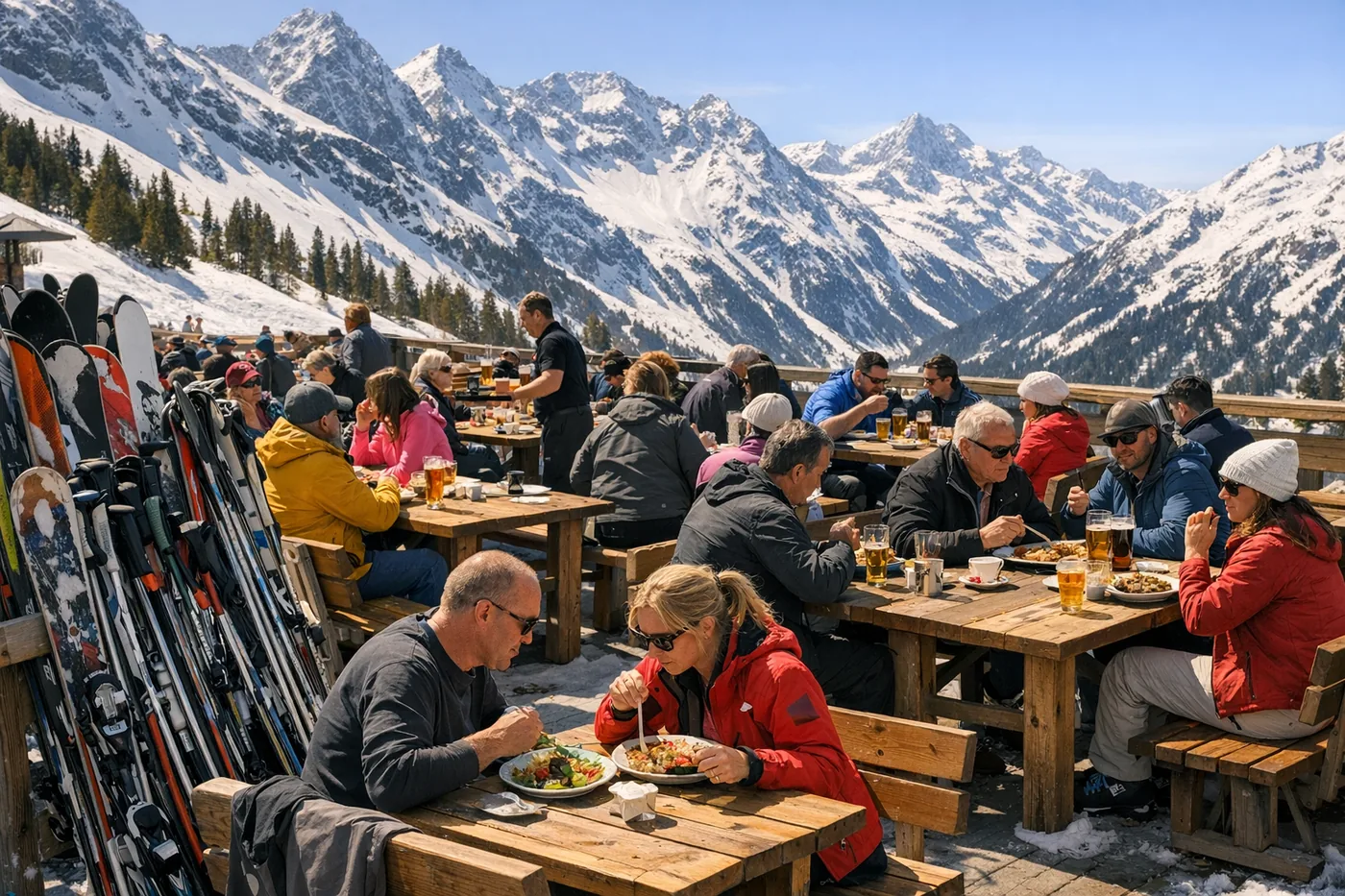
The price of a week in the Alps with hotel and lift pass included depends mostly on which resort you choose and when you travel. Budget-friendly resorts such as Flachau and Maria Alm outside peak season sit at the lower end, while New Year, half term and more exclusive resorts such as Ischgl fall at the upper end. A family with two adults and two children often comes out better value than the per-person price suggests, since many hotels offer child discounts.
You arrange the journey down yourself. If you drive your own car, fuel, road tolls and a hotel night in each direction come on top, and it pays off most when there are several of you in the car.
Accommodation with the lift pass included at 108 ski resorts in the Alps. You arrange your own travel there by car, train or plane.
How the price of the stay varies
The price of a ski holiday is governed first and foremost by three things: which resort you choose, when you travel and how early you book. A typical stay includes hotel with breakfast or half board and a lift pass for the whole week.
Here is a rough picture of price levels for a week with hotel and lift pass:
| Period | Price level |
|---|---|
| New Year week | Highest level of the season |
| January, regular week | Moderate |
| Half term | High |
| March, low season | Low to moderate |
| Easter week | Moderate |
Many hotels offer child discounts, and at some resorts children under a certain age stay free in their parents' room. Read more in our guide on family ski holidays.
Hotel with lift pass together, or booking it yourself?
Booking hotel and lift pass together is in most cases cheaper than arranging the parts separately. Operators negotiate volume discounts that are not available for individual bookings, and you avoid putting the logistics together yourself.
Another advantage is practical: the lift pass is ready waiting for you on arrival, and you know what the total price for the week will be before you travel.
Arranging everything yourself can pay off if you are very flexible with dates, travel outside peak season and are willing to spend time comparing. But for most people, particularly families, a package stay is both cheapest and simplest.
Accommodation with lift pass, driving down yourself
A common arrangement is to book the stay with the lift pass included in the price and make your own way down. That way you have a car available at the resort all week, and you decide the route yourself. This arrangement suits those travelling with a lot of luggage, bringing their own equipment, or travelling in a group of more than four.
Here is how to work out the cost of the drive:
- The route: the distance varies considerably depending on which ski resort you choose. Reckon on two days each way for most Alpine destinations, meaning a hotel night on the way down and one on the way home.
- Fuel: a typical family car with a roof box uses around 6 to 8 litres per 100 kilometres. Multiply the return distance by consumption, then by the price per litre at the pump when you travel.
- Eurotunnel: a crossing via the Eurotunnel from Folkestone to Calais is the quickest way onto the continent and lets you get straight on the road. Prices vary considerably by season and time of day, so compare dates.
- Road tolls: Austria and Switzerland require a vignette, with the Swiss one only sold as an annual vignette. Italy and France charge per stretch driven at toll booths. Some tunnels cost extra: the Tauern Tunnel 15 euros one way, the Brenner motorway 12.50 euros, and Mont Blanc or Fréjus 56 euros.
- Winter tyres: a legal requirement in Austria from 1 November to 15 April and in French mountain areas from 1 November to 31 March. Snow chains in the boot are often compulsory in Italy.
The sums work out best when there are more of you. If you are four adults, or a family with children, the cost is shared between more people, and the car can carry both equipment and luggage without extra charges.
Distances, road tolls country by country and tyre rules can be found in our guide Driving to the Alps.
What is included in the price, and what is extra?
A typical stay includes hotel or apartment with breakfast or half board, plus a lift pass for the whole week. You arrange the journey down to the Alps yourself. Ski hire and ski school are rarely included automatically, but can often be added at the time of booking.
Budget for the following costs in addition to the stay itself:
- Lift pass: included in the stays you find here, so you avoid this cost. For reference, an adult weekly pass costs around 300 to 400 euros at most Austrian resorts, 350 to 420 euros at Ischgl and Arlberg, and 400 to 480 CHF in the Swiss Jungfrau region.
- Ski hire: 100 to 180 euros for an adult per week, depending on equipment class. Children's equipment is cheaper. A helmet costs around 5 to 10 euros per day to hire.
- Ski school: group lessons for adult beginners cost 120 to 200 euros for a five-day week. A private lesson costs 60 to 100 euros per hour.
- Food and drink on-site: lunch, coffee breaks and apres-ski make up a good part of the budget. With half board included in the stay, you only need to budget for lunch on the slopes. A beer at apres-ski costs around 5 to 8 euros.
Budget resorts and premium resorts
The choice of ski resort is the single factor that matters most for the price. The difference between a budget resort and a premium resort can be considerable per person per week, for practically the same amount of skiing.
Budget: Flachau, Wagrain, Lofer, Maria Alm, Rauris and Dachstein West in Austria give the most skiing for your money. Flachau and Wagrain are also part of Ski amadé with 760 km of pistes on the same pass.
Mid-range: Schladming, Saalbach, Livigno and Canazei. Livigno has duty-free prices on food and equipment, which lowers on-site costs.
Premium: Ischgl, St. Anton and Grindelwald. Here you pay for world-famous skiing, nightlife and exclusivity. Switzerland is generally 30 to 50 per cent more expensive than Austria.
See the full list in our guide on cheap ski holidays.
How to keep costs down
- Book early. Early bookings during summer or early autumn often give 10 to 20 per cent off and the widest choice. Read more about when to book your ski holiday.
- Check what's included. The lift pass is included in the stays here, while ski hire and ski school are extra. See our guide is the lift pass included?
- Travel outside peak season. Avoid New Year and half term. January after New Year, early December and late March are the cheapest.
- Choose half board. Breakfast and dinner included is the most cost-effective way to eat at a ski resort.
- Watch for last-minute deals. Unsold stays can be sold at discounts of up to 40 per cent if you are flexible on resort and date.
- Hire equipment on-site. Hiring is easy and often cheaper for anyone who skis just one week a year, and you avoid transporting your own gear.
Compare ski holiday prices
See current stays with hotel and lift pass included in the price. You arrange your journey to the Alps yourself, and the earlier you book, the better the price.
Common questions about the cost of a ski holiday
The price of a week with hotel and lift pass included varies a great deal depending on resort and time of travel. Budget-friendly resorts such as Flachau and Maria Alm outside peak season sit at the lower end, while more exclusive resorts such as Ischgl and periods such as New Year and half term sit at the upper end of the scale.
Reckon on 300 to 400 euros for an adult weekly lift pass at most Ski amadé resorts in Austria. Ischgl and the Arlberg area cost a little more, around 350 to 420 euros. In the Swiss Jungfrau region a weekly pass costs around 400 to 480 CHF. Children under 15 often get heavily reduced prices, and sometimes travel free alongside a paying adult.
Booking hotel with lift pass together is usually cheaper, because the operator has negotiated volume discounts on accommodation and lift passes that individuals cannot access. You also avoid queuing for the pass on arrival. If you book the parts separately, you can occasionally find lower prices if you are very flexible, but it requires more planning.
The cost of driving depends on how far you travel. A family car with a roof box typically uses around 6 to 8 litres per 100 kilometres, and on top of the fuel comes the vignette in Austria and Switzerland, toll charges in Italy and France, certain tunnel fees, plus a hotel night in each direction. The cost is shared between everyone in the car, so driving becomes considerably better value with four people than with two, particularly if you bring your own equipment.
A week of adult ski hire normally costs 100 to 180 euros depending on resort and equipment class, and a helmet around 5 to 10 euros per day. Group ski school for adult beginners costs 120 to 200 euros for a five-day week. Private lessons cost 60 to 100 euros per hour.
Beyond ski hire and lift pass, you should budget for lunch, coffee and an apres-ski drink each day. If your stay includes half board, it is enough to budget for lunch and a snack on the mountain. In lively resorts such as Ischgl, evening costs can be noticeably higher.