
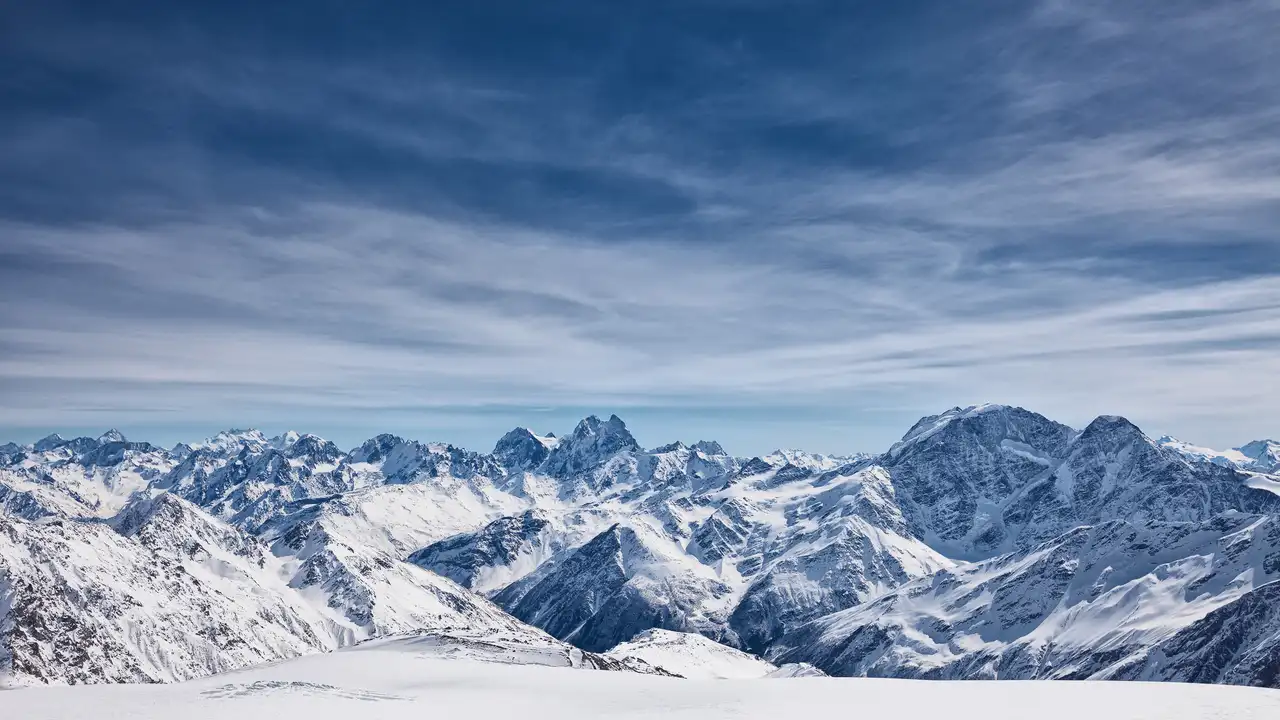
Short answer: which countries lie in the Alps?
The Alps are Europe's largest continuous mountain range and stretch across eight countries: France, Italy, Switzerland, Austria, Germany, Slovenia, Liechtenstein and Monaco. The mountain range is around 1,200 km long, up to 250 km wide at its widest point, and covers an area of around 200,000 square kilometres.
The largest share of the Alps lies in Austria (where 65 per cent of the land area is Alpine), closely followed by Switzerland with 60 per cent. Italy has the largest absolute area thanks to the country's elongated shape. Most ski resorts and the most visited destinations lie in Austria, France, Italy and Switzerland.
The 8 countries of the Alps
1. Austria
Around 65 per cent of Austria's area lies in the Alps. The country has over 250 ski resorts, more than any other Alpine country, and is the most popular choice among British skiers on holiday. Here you'll find classics such as St. Anton, Ischgl, Saalbach and Bad Gastein. The most snow-sure are Obertauern and Obergurgl, while Flachau and Wagrain are the most popular family resorts. See all our ski holidays to Austria, or all the ski resorts we guide to.
2. Switzerland
Switzerland has around 60 per cent of its land area in the Alps and is home to many of the mountain range's most spectacular peaks, including the Matterhorn and the Eiger. Switzerland has the highest prices of all Alpine countries, but offers unrivalled quality of slopes, lift systems and accommodation. Best known to us are Zermatt, Grindelwald, Verbier and St. Moritz. See our ski holidays to Switzerland.
3. France
The French Alps are home to the world's largest continuous ski areas, such as Les Trois Vallees (600 km of pistes) and Paradiski (425 km of pistes). Famous resorts such as Val Thorens, Meribel, Tignes and Chamonix attract advanced skiers and apres-ski enthusiasts alike. For France, we sell stays with hotel and lift pass included, while you arrange the journey there yourself, for example via the Eurotunnel from Folkestone. See our ski holidays to France.
4. Italy
The Italian Alps stretch along the entire northern border, from the Aosta Valley in the west to Friuli in the east. Italy tempts with lower prices, fantastic food and unique resorts such as Cervinia (beneath the Matterhorn), Livigno (tax free) and the Dolomites with Cortina d'Ampezzo, Canazei and Alta Badia. See our ski holidays to Italy.
5. Germany
The German Alps form a narrow strip in the southern part of the country, mainly in the state of Bavaria. The main ski resort is Garmisch-Partenkirchen, at the foot of Germany's highest mountain, the Zugspitze (2,962 m). The area is less well known internationally, but popular among German and Austrian skiers.
6. Slovenia
The Slovenian Alps (the Julian Alps and the Karawanks) lie in the north-western part of the country. Triglav is the highest peak at 2,864 m. Ski resorts such as Kranjska Gora and Vogel offer affordable alternatives with shorter queues and an authentic atmosphere. Increasingly popular among budget-conscious travellers.
7. Liechtenstein
The world's fourth smallest country lies entirely within the Alps. Its entire area of 160 square kilometres is mountainous. Liechtenstein has two ski resorts, Malbun and Steg, both small but charming, with excellent family areas. Good for a day trip from neighbouring countries.
8. Monaco
The principality of Monaco borders the southern foothills of the Alps, more specifically the Maritime Alps. Monaco has no skiing of its own since the country is a coastal city, but is formally counted among the Alpine countries because the mountain range ends just outside the city boundary and strongly influences the climate.
Which country is best for British skiers?
The choice depends on what you prioritise. Here's a brief guide:
| Country | Best for | Price level |
|---|---|---|
| Austria | First timers, apres-ski, families | Low to medium |
| France | Advanced skiers, large ski areas | Medium to high |
| Italy | Food, snow reliability, good value | Low to medium |
| Switzerland | Scenery, premium quality | High |
| Slovenia | Budget, short queues | Low |
| Germany | Day trips, proximity | Medium |
Frequently asked questions
How many countries do the Alps stretch across?
The Alps stretch across 8 European countries: France, Italy, Switzerland, Austria, Germany, Slovenia, Liechtenstein and Monaco. It is the largest continuous mountain range in Europe, roughly 1,200 km long and up to 250 km wide at its widest point.
Which country has the largest share of the Alps?
Austria has the largest share of the Alps by area, with around 65 per cent of the country covered by mountains. Switzerland has approximately 60 per cent of its land area within the Alps, while Italy has the largest absolute area in the mountain range thanks to its elongated shape.
Which Alpine country is best for skiing?
Austria is the most popular choice among British travellers thanks to a wide range of ski resorts, good infrastructure and reasonable prices. France has the largest continuous ski areas (Les Trois Vallees, Paradiski). Italy tempts with lower prices and great food. Switzerland offers spectacular scenery, but is the most expensive.
How high are the Alps?
The highest peak in the Alps is Mont Blanc at 4,808 metres, on the border between France and Italy. There are over 80 peaks in the Alps higher than 4,000 metres, and most of them are in Switzerland and Italy.
Do Liechtenstein and Monaco really lie in the Alps?
Yes. Liechtenstein lies entirely within the borders of the Alps and is one of the world's smallest countries, with two ski resorts (Malbun and Steg). Monaco borders the southern foothills of the Alps, but has no skiing of its own as it is a coastal city.
What language is spoken in the Alps?
Four main languages are spoken in the Alpine region: German (in Austria, Switzerland, Germany and northern Italy), French (in France and western Switzerland), Italian (in Italy and southern Switzerland) and Slovenian (in Slovenia). English works well at all ski resorts.